Provider review · Updated October 15, 2026
Sterling Private Medical microdose review: identify the medicine behind the offer
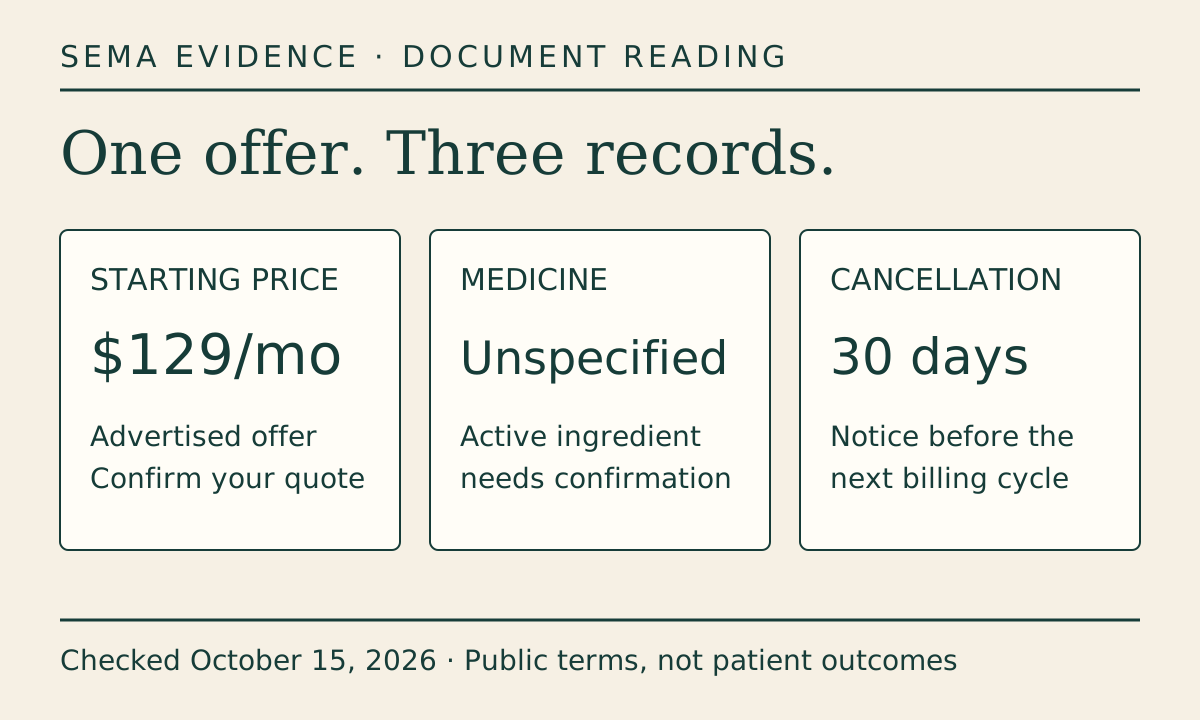
A $129 starting price, a 30-day cancellation notice, and a GLP-1 description that leaves the microdose ingredient unresolved.
Public-document editorial research · Method and limitations
Sterling Private Medical places a GLP-1 microdose program beside separate semaglutide and tirzepatide programs. That layout makes the service relevant to someone researching semaglutide microdosing, but it does not establish which ingredient the microdose program uses. Our first finding is therefore an identity gap: a familiar category name cannot substitute for the proposed prescription.
We reviewed Sterling’s public homepage and microdose page on October 15, 2026. This is an assessment of published terms and claims. We did not complete an assessment, purchase treatment, verify an assigned clinician or pharmacy, or test the service. The publication’s CoreAge Rx commercial relationship remains disclosed separately from this review.
Article contents
A program name is not a complete medication record
The microdose page describes compounded medication from partner pharmacies in the United States. It does not identify semaglutide or tirzepatide as the active ingredient of this particular program in the material reviewed. The homepage lists those two medicines as separate options. We therefore do not label the microdose offer a verified semaglutide prescription.
Before comparing it with CoreAge’s specifically named semaglutide offer, obtain the proposed ingredient, formulation, dispensing pharmacy and intended purpose. The terminology guide explains why the word microdose supplies none of those details by itself. This distinction also prevents an advertised program from being mistaken for an approved medication brand.
The $129 headline belongs to a qualified starting offer
Sterling’s homepage pricing panel advertises GLP-1 Microdose from $129 per month. It says medication, supplies, delivery and concierge care are included. The same page also says pricing is confirmed after consultation. Those statements support a dated description of the offer, not a verified total for a specific patient or billing period.
The microdose FAQ advertises no consultation charges and no dose-change surcharges. Ask how the initial charge, refill schedule and included quantity appear in the actual agreement. A flat-price promise does not establish the amount of medication supplied, and an advertised monthly figure does not tell us whether additional clinical services are required. We did not test checkout or confirm a personalized quote.
Cancellation has a notice period and a separate refund boundary
The microdose FAQ says membership cancellation requires 30 days’ notice before the next billing cycle. It separately describes consultations, medical visits and fulfilled prescriptions as non-refundable after services begin or medication is processed. Those qualifications matter more than a general impression that an online program is easy to stop.
A reader should establish the next billing date, how notice is submitted, when medication processing begins and which charges the refund restriction covers. The page’s no-consultation-charge wording and its non-refundable-consultation wording should be reconciled in the selected agreement. We cannot tell from those phrases alone whether a particular consultation would generate a charge or what cancellation would cost.
Composition and tolerability claims need their own evidence
Sterling markets this program around body composition, appetite changes and metabolic refinement. It also describes lower doses as preserving benefits with fewer trade-offs. These are provider claims. The reviewed page does not supply an identifiable trial establishing those outcomes for its exact compounded preparation, population and prescribing approach.
Its published month-one, month-three and later milestones should therefore be read as the provider’s proposed timeline, not as a forecast we independently verified. Our longevity evidence discussion separates a biological rationale from an observed clinical outcome. AgelessRx’s review provides another example of why survey results, research descriptions and a specific treatment offer require separate reading.
Compounding remains a distinct regulatory question
Sterling identifies compounded medication in its included-services description. FDA’s GLP-1 guidance explains that unapproved preparations do not undergo the agency’s premarket review for safety, effectiveness and quality. A physician-directed service, domestic pharmacy location or low-dose label does not convert that preparation into an FDA-approved product.
The unresolved ingredient identity makes precision especially important here. We cannot assess a formulation that has not been specified, establish equivalence to an approved product, or infer a legal basis for an individual prescription from marketing alone. The compounding and salt-form guide describes the records a medication-specific assessment would need. This review gives no dosing, measuring or injection instructions.
Concierge access is different from a measured clinical response
The program page promises physician-directed care, structured check-ins and around-the-clock secure messaging. It also refers to a concierge team. These statements describe the intended service model; they do not establish that the prescribing clinician personally replies at every hour or that a particular response time is guaranteed.
Ask who receives an administrative message, who handles medication concerns and how a clinician is reached when follow-up is needed. The homepage advertises nationwide telehealth, but we did not verify a clinician’s availability in any particular state. The care comparison helps distinguish access claims from the assigned responsibilities that would appear in a patient’s own care arrangement.
The decision starts with identity, then the agreement
Sterling provides enough public detail to identify a microdose service, a starting price and a cancellation notice requirement. The most consequential unanswered question remains the medicine in that service. Confirm that before using the $129 figure to compare semaglutide offers, and obtain the actual billing and cancellation terms before relying on the advertised bundle. The program record is the source for those commercial observations.
Its claims about composition, metabolic effects and tolerability remain separate from the contract. A clear bill would not validate those outcomes, while a clinician’s assessment would not erase the stated cancellation window. Our conclusion is a document-based comparison with specific unresolved questions, rather than a clinical endorsement or a report of treatment results.
Source documents
A provider record supports a statement about its public description. Trial reports and product labels answer different questions and retain their own population, formulation and outcome limits.
- Sterling Private Medical: program descriptions and starting pricesProvider offer · Checked 2026-10-15
- Sterling Private Medical: GLP-1 Microdose program and cancellation FAQProvider terms and claims · Checked 2026-10-15
- FDA: Concerns with Unapproved GLP-1 Drugs Used for Weight LossRegulatory guidance · Checked 2026-10-15